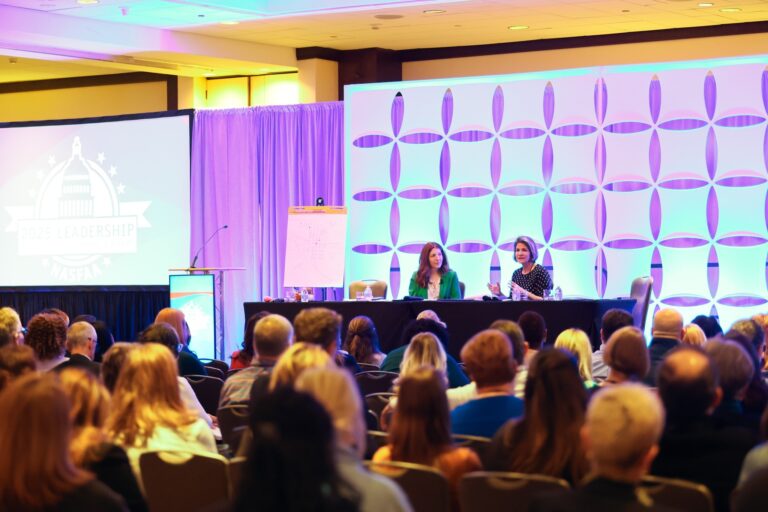
The Federal Student Aid session at the 2026 NASFAA Leadership Conference offered a substantive look at where the department stands on FAFSA operations, loan repayment restructuring under the One Big Beautiful Bill Act (OBBBA), and the rulemaking process still underway for Workforce Pell and accountability. Led by Richard Lucas, Acting Chief Operating Officer of Federal Student Aid, and joined by FSA colleagues covering FAFSA, loan repayment, policy implementation, and verification, the session was candid about both progress and unresolved questions. Here is what we heard.
Richard Lucas
Mission, Accountability, and the Loan Repayment Crisis
Lucas opened with a clear statement of purpose. With nearly forty years at the Department of Education, he framed the work of financial aid professionals not as administration, but as mission delivery-the mechanism by which students who lack access to opportunity find it. He was direct about what that means operationally: anything that disrupts student access to aid is unacceptable.
On the state of the student loan portfolio, Lucas named what he called a national crisis: less than forty percent of all borrowers are currently in repayment on a portfolio approaching $1.7 trillion. His message to institutions was explicit, all schools should be conducting sustained outreach to former students who are delinquent or in default. This is not a suggestion; rising cohort default rates carry real consequences for Title IV participation.
Lucas closed his remarks by proposing three shared commitments between FSA and the financial aid community. In his words:
- “Forward focus” – don’t be defined by past failures; keep eyes on what is possible and on rebuilding trust in the system.
- “Bold accountability” – own outcomes, embrace data, and be honest about performance, especially when it is uncomfortable.
- “Relentless service” – students, families, and taxpayers are the North Star.
FAFSA Operations
Improved Performance, Real-Time Fraud Prevention, and Partner Connect
The 2026-27 FAFSA cycle is tracking well. With nearly ten million starts, eight million submissions, and a ninety-six percent satisfaction rate, FSA presented a meaningful improvement from prior cycles. FAFSA Simplification has resulted in 1.7 million additional students becoming Pell-eligible compared to the pre-simplification baseline. Contact center hold times are running under a minute.
The more consequential update for institutions is FSA’s shift on fraud. The department is moving toward real-time identity verification on the FAFSA itself, using an AI-based scoring model. Going forward, suspected fraudulent filers will be intercepted before completing the FAFSA rather than flagged for institution-side verification. FSA confirmed it will raise its fraud score threshold from ninety-four to ninety-six after finding that ninety-nine scored accounts had a false positive rate near zero. Once fully implemented, FSA expects school verification rates to drop significantly – below even pre-elevated levels.
FSA is committed to having the system live, with full training and guidance, before the 2026-27 disbursement season begins.
Partner Connect access disruptions remain an ongoing problem, particularly for staff who change institutions. FSA acknowledged the issue and is investing in improvements. Institutions with access problems that are actively blocking aid delivery were encouraged to escalate by contacting NASFAA.
Loan Repayment
IBR Changes Now in Effect, Parent PLUS Cutoff Approaching
FSA confirmed that effective December 22, 2024, the partial financial hardship cap for entering Income-Based Repayment has been removed. Most borrowers can now access IBR regardless of income or family size, with monthly payments capped at the ten-year standard repayment amount. In addition, Parent PLUS borrowers who have consolidated and made at least one payment under Income-Contingent Repayment can now enter IBR-a significant benefit for that population.
Institutions advising graduate students and their families need to understand one critical cutoff: any Parent PLUS borrower with a first disbursement on or after July 1, 2026, loses access to both IBR and ICR entirely. Those borrowers will only have access to the new repayment plans being developed under OBBBA. This is a material change that affects counseling, borrower outreach, and institutional communications now.
FSA was otherwise limited in what it could share on loan provisions, given that several OBBBA items remain inside the active negotiated rulemaking process. Institutions were encouraged to submit formal comments through regulations.gov by March 2, 2026 and to engage NASFAA as an advocacy channel.
Workforce Pell and Accountability
Two NPRMs, Active Comment Period
The AHEAD negotiated rulemaking table covers both Workforce Pell and the new accountability framework. These will be published as two separate notices of proposed rulemaking (NPRMs) -Workforce Pell first, accountability second. Both will soon be approaching the public comment period, and FSA strongly encouraged institutions to engage.
At its core, Workforce Pell creates Pell eligibility for programs between 150 and 599 clock hours. Those programs will be subject to a value-added earnings metric: if graduates do not meet an earnings threshold three years post-completion (adjusted for regional price parity), the program’s tuition and fees will be capped accordingly. FSA is developing the calculation methodology in coordination with the Department of Labor, which now has a formal role in workforce program oversight.
The accountability provisions affect direct loan eligibility and will similarly use graduate earnings data to evaluate program value. FSA urged institutions to read the rulemaking package carefully, noting that the cohort definitions used in these calculations carry significant implications for how programs are evaluated.
Schedule Reductions and Loan Proration
Operational Questions Without Final Answers
The Q&A surfaced what is, for many institutions, the most pressing implementation gap: the enrollment-based loan proration provisions (referred to in the bill as “schedule reductions”) are moving closer. Implementation is with 2026-27 FAFSA aid, which could be disbursed prior to July 1, and there are significant operational questions still unresolved. How a mid-semester withdrawal affects the full-time determination for a subsequent semester, how required summer terms factor into the annual enrollment definition, how graduate programs with variable credit loads apply the standard-none of these have formal guidance yet.
FSA acknowledged the gap and was candid about the timing problem: official guidance may be difficult to issue while the public comment period is active. The department is tracking cases and asked institutions to keep raising scenarios. For schools with summer disbursements beginning before July 1, or crossover loan periods that span the effective date, the absence of clear guidance creates real operational risk. Institutions should be documenting their interim approaches and monitoring FSA’s Knowledge Center and training center closely.
Verification, PPA Requirements, and 2026-27 Pell Grant Amounts
No major changes to 2026-27 verification requirements relative to 2025-26. Institutions with students in V4/V5 verification retain their existing flexibilities. FSA reminded institutions that verification outcome reporting in the FAFSA Partner Portal is required within no more than sixty days, and that step-by-step training is available at the FSA Training Center.
Proprietary institutions should review Electronic Announcement GEN-26-04. Guidance issued January 16, 2026 clarifies when an owner entity of an eligible institution is required to sign a Program Participation Agreement. The Secretary of Education is currently exercising discretionary waiver authority over this requirement, but the department reserved the right to reimpose it as circumstances warrant.
Maximum Pell for 2026-27 remains $7,395. Minimum Pell remains $740. These amounts were confirmed following passage of the Consolidated Appropriations Act of 2026 (FY2026 federal budget) and are unchanged from the January 30 posting.
McClintock’s Perspective
Several themes from this session are directly relevant to the institutions we work with. The department’s expectation around default prevention outreach is no longer ambiguous, Lucas named it as a shared obligation, and institutions that are not actively engaging delinquent former students are exposed. This is a concern we addressed in our recent analysis, Student Loan Crisis Deepens: 4 Million Borrowers Now Delinquent. The July 1, 2026 Parent PLUS IBR/ICR cutoff is a counseling and communication issue that needs attention now, not in June. And for institutions with programs in the 150-599 clock hour range, the Workforce Pell and accountability NPRMs represent a significant regulatory development that warrants careful review and formal comment.
On schedule reductions and loan proration, we share the community’s concern about the guidance timeline. Institutions with borrower-based academic calendars, summer headers, or crossover loan periods face real implementation decisions before final guidance arrives.