
A follow-up to our January 2025 article on the new Return of Title IV Funds regulations.
It’s been a minute since we last wrote about the new Return to Title IV (R2T4) rules. Back in January 2025, we covered the two provisions institutions could implement as early as February 3, 2025—the optional New Withdrawal Exemption (now renamed the Full Refund Withdrawal Exemption) and the leave of absence flexibility for eligible Prison Education Programs (PEPs)—and then we waited. Most institutions did the same, holding off on operational changes until the Department issued additional guidance and the regulatory effective date got closer.
That guidance is now here. On March 27, 2026, the Department released Electronic Announcement GENERAL-26-20, providing additional information on the remaining R2T4 provisions that take effect July 1, 2026, with no option for early adoption, and providing additional implementation detail on the provisions already in effect.
We know July 1 already has plenty of other big, beautiful items demanding institutional attention. Our goal here is simply to make sure the R2T4 changes don’t slip off the radar. These changes apply to students who withdraw, otherwise cease attendance, or begin an approved leave of absence on or after July 1, 2026.
Here’s what your financial aid office needs to know.
1. The 14-Day Documentation Rule (Codified)
For institutions required to take attendance, the regulations now codify longstanding guidance: the institution must document its determination that a student withdrew no later than 14 days after the student’s last date of attendance (LDA).
Important nuance: the 14-day clock is for documenting the withdrawal date, not for administratively withdrawing the student. Schools still have time to determine whether the student has truly withdrawn or is simply absent. Once the date of determination (DOD) is set, however, the existing deadlines apply (including exit counseling, NSLDS reporting, post-withdrawal disbursements, etc.).
A few of the key ones to keep in mind:
- R2T4 calculation: completed within 30 days of the DOD.
- Return of funds to the Department: no later than 45 days following the DOD.

Action item: Review attendance-tracking workflows to confirm the 14-day documentation timeline is captured in policy and that the handoff between attendance, registrar, and financial aid is tight.
2. Clock-Hour Calculations: One Method, but Same Two Timeframe Options
This rule change is the one most likely to be misunderstood including by software vendors. Here’s what changed: under the prior regulation, the Department accepted two formulas for calculating “Hours Scheduled to Complete” (the numerator in Step 2 of the R2T4 calculation):
- The cumulative method: Total cumulative scheduled hours through the withdrawal date, minus hours completed in prior payment periods.
- The payment period method (often called the “exact” method at McClintock): Total scheduled hours accruing from the point the student began attendance in the current period forward.
Effective July 1, 2026, the revised regulatory text at 34 CFR § 668.22(f)(1)(ii)(A) eliminates the cumulative method. Schools must now divide the total clock hours in the period into the hours scheduled to be completed since the student began attendance in the payment period or period of enrollment as of the withdrawal date (which is the LDA).
Side-by-side example. Using the Department’s example from GENERAL-26-20: an academic year of 900 hours with two 450-hour payment periods. The student attends 8 hours/day, completes payment period #1 (PP1) on day 68, and withdraws on day 70 or two days into payment period #2 (PP2). Cumulative scheduled hours through day 70 = 560.
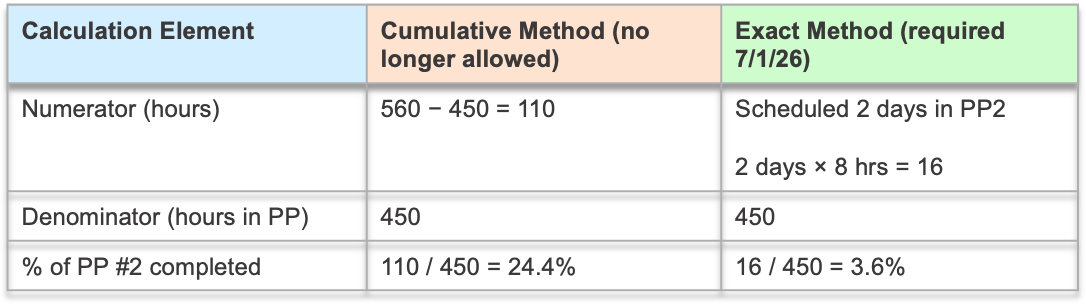
As you can see, the cumulative method produced a much higher “percentage earned” for the second payment period and, therefore, more aid retained by the institution. Eliminating the cumulative method narrows the calculation to the hours actually scheduled since the student began the new period.
3. Module Programs: Simpler—and No More Freeze Dates
This is one of the most welcome simplifications. For programs offered in modules, a module is included in the denominator of the R2T4 calculation only if the student actually begins attendance in that module.
What this means in practice:
- R2T4 Freeze Dates are no longer applicable.
- The type of Title IV aid the student received and whether the school used a Freeze Date no longer affect how the days in the denominator are counted.
- Schools no longer need to look at which modules a student was scheduled to attend in the payment period.
Action item: If your institution offers modular programs, retire your Freeze Date policy effective July 1, 2026, and update procedures, training materials, and any third-party servicer instructions accordingly.
4. Updated Guidance on the Full Refund Withdrawal Exemption
Since our earlier article, the Department has filled in several practical details about how the optional Full Refund Withdrawal Exemption works in real life. The most useful clarifications:
- You still have to keep records. While your institution may treat a student as never having attended, in reality, that student did begin attendance. Therefore,it does not erase your underlying recordkeeping obligations. Eligibility documentation and attendance records must still be on file to support the determination that Title IV funds were initially awarded properly. Your auditor will ask for this support.
- Don’t confuse this with a true never-attended scenario. The provisions at 34 CFR 668.21 are written for students who never began attendance at all. Students who actually started attending and are merely being treated as if they hadn’t are outside that regulatory framework.
- Continued enrollment in any course, even an audited one, breaks the exemption. If the student is still on a roster anywhere on campus during the period, you cannot honestly assert they never attended, so one of the four required criteria fails. Plan to apply this exemption only when the student is fully out of all coursework for the period.
- “All institutional charges” really does mean all of them. Tuition and fees are obvious. Less obvious: institutionally-billed books and supplies, contracted housing, meal plans, and similar charges all have to come off too. There’s no partial refund pathway here.
- Enrollment reporting hinges on prior attendance. If the student never attended your institution before this period, report status code ‘X’ (Never Attended). If the student attended in a prior period, report ‘W’ (Withdrawn) and backdate the withdrawal to the LDA of the last period actually attended. Watch out for the downstream effect on grace periods and repayment, as backdated withdrawal can quietly accelerate either one.
More detailed enrollment-reporting guidance is expected in a forthcoming update to the NSLDS Enrollment Reporting Guide.
Q&A: Common Misconceptions We’re Already Hearing
Q1: Our student information system (SIS) vendor told us the new rule requires all clock-hour programs to use the payment period as the timeframe and that the “period of enrollment” option is going away. Is that right?
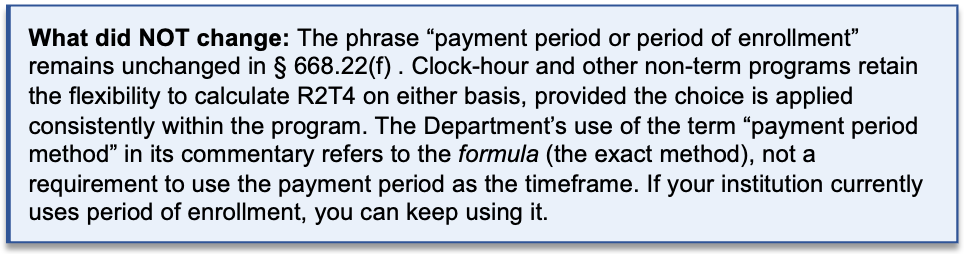
A1: No. The phrase “payment period or period of enrollment” remains in § 668.22(f). What the final rule eliminated is the cumulative formula for the numerator, not the period-of-enrollment timeframe. Non-term and clock-hour programs may continue to use either timeframe, applied consistently. The Department’s reference to a “payment period method” in its commentary refers to the formula, not the timeframe. If your vendor is preparing to remove the period-of-enrollment option, push back! It would exceed what the regulation requires.
Q2: We’re an attendance-taking school. What date triggers the new R2T4 rules?
A2: The new R2T4 rules apply to students who withdraw, otherwise cease attendance, or begin an approved LOA on or after July 1, 2026. For attendance-taking institutions, the withdrawal date is the LDA, so the trigger is the student’s last date of attendance, not the date of determination. A student with an LDA of June 30, 2026 is under the old rules even if you don’t determine the withdrawal until mid-July.
Q3: Do we have to use the new Full Refund Withdrawal Exemption?
A3: No. It’s optional and can be applied on a student-by-student basis according to your written policy. But if you do use it, all four criteria must be met (treat as never attending, return all Title IV funds and credit balances, refund all institutional charges, and write off any remaining period balance owed), in addition to maintaining eligibility and attendance documentation.
Q4: We have a student who stopped attending Title IV eligible classes but is still attending an audited course. Can we use the Full Refund Withdrawal exemption?
A4: No. Because the student is still recorded as attending classes during the period, you can’t treat them as never having attended, which is one of the four required criteria.
Q5: Are R2T4 Freeze Dates still a thing?
A5: Not after July 1, 2026. A module is part of the denominator only if the student actually begins attendance in it. The type of Title IV aid involved no longer matters for this determination. You can retire your Freeze Date policy as of the implementation date.
Q6: A module included in the denominator has a scheduled break of five or more days. Do I still exclude those days from the calculation?
A6: Yes. The existing rules around scheduled breaks of five or more consecutive days still apply. The new regulations changed how you decide whether a module is included in the denominator in the first place, but once it’s included, the long-standing treatment of scheduled breaks within that period hasn’t changed.
Q7: Are the half-time and 49% exemption rules still in effect, or have those changed?
A7: Still in effect, and please don’t forget them. Both threshold checks must be completed up front to determine whether an R2T4 calculation is even required. The new regulations do not modify either rule.
Q8: If we’re a non-attendance-taking institution, does the 14-day documentation rule apply to us?
A8: No. The 14-day rule is specific to institutions required to take attendance. If you’re a non-attendance-taking institution, continue to follow the existing FSA Handbook guidance for determining a student’s withdrawal date and date of determination.
Getting Ready for July 1, 2026
With the implementation date approaching, institutions should be working through the following now:
- Update your R2T4 policies and procedures to reflect any applicable changes such as the 14-day documentation rule, the elimination of the cumulative clock-hour method, and/or the elimination of Freeze Dates.
- Confirm your timeframe selection for clock-hour and other non-term programs (payment period vs. period of enrollment) and document it. Both remain allowable but the institution must use the same basis for all students within a particular program.
- Coordinate with your software/SIS vendor to confirm system updates align with the new rules and verify they aren’t over-implementing by removing options the regulation still permits.
- Train financial aid, registrar, and attendance staff on the new timelines and decision points.
- Decide your institutional position on the optional Full Refund Withdrawal Exemption and document the decision either way.
- Watch for the 2026–27 FSA Handbook (Volume 5), which will contain complete guidance on all R2T4 provisions effective July 1, 2026.
Sources:
- U.S. Department of Education, Federal Student Aid. Electronic Announcement GENERAL-26-20: Implementation of Return of Title IV Funds (R2T4) regulations effective July 1, 2026 (March 27, 2026).
- Final Rule, Student Assistance General Provisions, Federal Perkins Loan Program, Federal Family Education Loan Program, William D. Ford Federal Direct Loan Program, and Teacher Education Assistance for College and Higher Education Grant Program, 90 Fed. Reg. 470 (Jan. 3, 2025).
- 34 CFR § 668.22 – Treatment of Title IV funds when a student withdraws (effective July 1, 2026).
- U.S. Department of Education, 2025–26 Federal Student Aid Handbook, Volume 5.
______________________________
At McClintock & Associates, we’re committed to keeping you informed—even when the rules are still being written. Sign-up for our newsletter to stay up to date.